
The Short Answer
Renovating is not automatically cheaper than tearing down. Decide on the house, not the assumption.
- A major renovation and a new build often land at similar price points, and sometimes rebuilding is a little less.
- We lean hard toward saving the house you have. Structure, ceiling heights and zoning are what usually decide it.
- Real ranges for renovations and additions in Charlotte and Lake Norman are in our Investment Guide.
Most homeowners come to us assuming that renovating the house they have will cost much less than tearing it down and starting over. Sometimes it does. Just as often, a large renovation and a new build land at very similar numbers, and once in a while rebuilding comes out a little ahead.
We would rather save a house than replace it. There is something right about breathing new life into a home a family already loves and fixing the things that never worked. But the decision should rest on the house, the lot and the rules, not on an assumption. Here is how to think it through.
Why renovating is not automatically cheaper
A renovation keeps the parts of the house that are worth keeping, and it pays for the privilege. Demolition happens carefully, around everything that stays. Old framing has to be checked and sometimes corrected. Walls, floors and rooflines that were never meant to change have to be tied into new ones. Heating, cooling, electrical and plumbing usually need to be brought up to the new house anyway.
Older houses add their own requirements. In a home built before 1978, the work has to follow the EPA's lead-safe rules. Aluminum branch wiring from the 1960s and early 1970s is a known fire risk that the Consumer Product Safety Commission has studied for decades, and it usually comes out. Any work that disturbs regulated amounts of asbestos needs advance notice to Mecklenburg Air Quality.
A new build skips the careful demolition and the tie-ins and starts on a clean lot, but it brings its own costs: demolition of the whole house, a complete new foundation and every system from scratch. When the renovation touches most of the house, the two paths end up much closer than people expect. Charlotte's own numbers show how often the math tips: the UNC Charlotte Urban Institute counted more than 1,000 demolitions in 2019, most of them homes, and pointed to high land values and aging houses as the reason demolition can win out over remodeling.
People think renovating will save them a bunch of money. A lot of times it is a very similar price point.
 Max Messenger, Owner
When renovating is the right call
- The house means something. A home with historic character, or one your family has lived in for decades, carries value a new build cannot replace.
- The structure is sound and the problems are solvable. A dark kitchen, a cramped primary suite or a layout that fights you can usually be fixed without starting over.
- You love the street and the lot. Staying and expanding keeps the neighborhood, the trees and the setting you chose in the first place.
- The house sits where today's rules would not let you build. An older home closer to the property line than current setbacks allow can often be renovated in place. Tear it down, and the new house may have to sit farther back.


When rebuilding wins
- The ceilings are the problem. In a house that is already two stories, low ceilings are often a pain point that cannot be solved. Raising them means rebuilding the floor and the roof above, and at that point you are close to a new house.
- The foundation or framing is failing. When the bones need replacing, there is little left to save.
- The renovation would touch almost everything. If every wall, system and finish is changing, the cost advantage of keeping the house shrinks toward nothing.
- The rules change once the renovation gets big enough. More on that below, because it catches people by surprise.
The zoning trap: when a renovation has to meet today's rules
Many older houses in Charlotte and around the lake sit closer to the property line, or cover more of the lot, than today's rules allow for a new house. Most towns let a house like that stay as it is. In Charlotte, the development ordinance lets a nonconforming house be renovated without bringing it into conformity, though any expansion has to meet today's standards. A teardown gets no such protection. The new house has to meet the current rules: in Charlotte's N1 neighborhoods, front setbacks of 10 to 27 feet, rear setbacks of 20 to 40 feet and 5 feet on each side, with building coverage capped at 40 or 50 percent of the lot (UDO Article 4).
Some towns draw the line with a percentage, and Davidson has several 50 percent tests in its planning ordinance:
- Damage. A nonconforming house damaged beyond half its tax-assessed value can only be rebuilt to current standards (section 12.2.2).
- The Lake Norman watershed. A project counts as an expansion only if it keeps at least half of the existing heated floor area. Take out more, and the lot has to meet the watershed's impervious-surface limits as new development (article 17).
- Design standards. Rebuilding half or more of a facade, or adding half or more to a one-story house's first floor, brings the whole house under the town's design rules (section 4.7).
- Floodplain. A renovation that removes two exterior walls and costs at least half the house's market value counts as new construction (article 18).
We have seen this firsthand in Davidson. A renovation crossed one of the town's thresholds, the house had to meet the setbacks for new construction, and the project became a new build. Mooresville has a similar test, holding a house damaged or destroyed by any means beyond half its replacement cost to current rules (UDO 7.3.5). The lesson is simple: before you design a large renovation, find out where your town draws the line, and design on the right side of it.
What a teardown adds to the list
Rebuilding is not just renovation without the old house. It brings its own approvals, and they belong in the comparison.
- A demolition permitIn Mecklenburg County, pulled by a bonded contractor, with an asbestos notice to Air Quality, a Health Department demolition application and erosion control (county demolition permits).
- Heritage tree reviewIn Charlotte, a new house brings the heritage tree protections into play and has to plant trees along the street frontage. Protected trees can shape a renovation too: on our Lansdowne addition, the footings went in under an urban forestry permit.
- Today's setbacks and coverageThe new house has to fit the current rules, which can mean a smaller footprint than the house it replaces.
- Historic district timingIn a Charlotte local historic district, demolition can be delayed up to 365 days.
The questions that decide it
These are the things we look at with every family weighing the two paths, and the order we look at them in.
- 01
The structure
Foundation, framing and roof: what is sound, what needs correcting and what would have to be replaced.
Find out firstHave a builder walk the house before you choose a path.
- 02
Ceiling heights and floor levels
Whether the rooms can be the height you want without rebuilding the floor or roof above them.
Find out firstMeasure the rooms you care about most.
- 03
How much of the house changes
The more of the house a renovation touches, the closer its cost gets to a new build.
Find out firstList what stays exactly as it is.
- 04
The rules on your lot
Setbacks, historic district review, large trees and, around the lake, shoreline buffers can favor one path or the other.
Find out firstCheck how your town treats a large renovation of an older house.
- 05
What the house means to you
Character, history and a family's years in a home are real value, even when the spreadsheet is close.
Find out firstDecide what you would miss.

Kept and expanded
A 1953 house, a growing family, and no wish to leave.
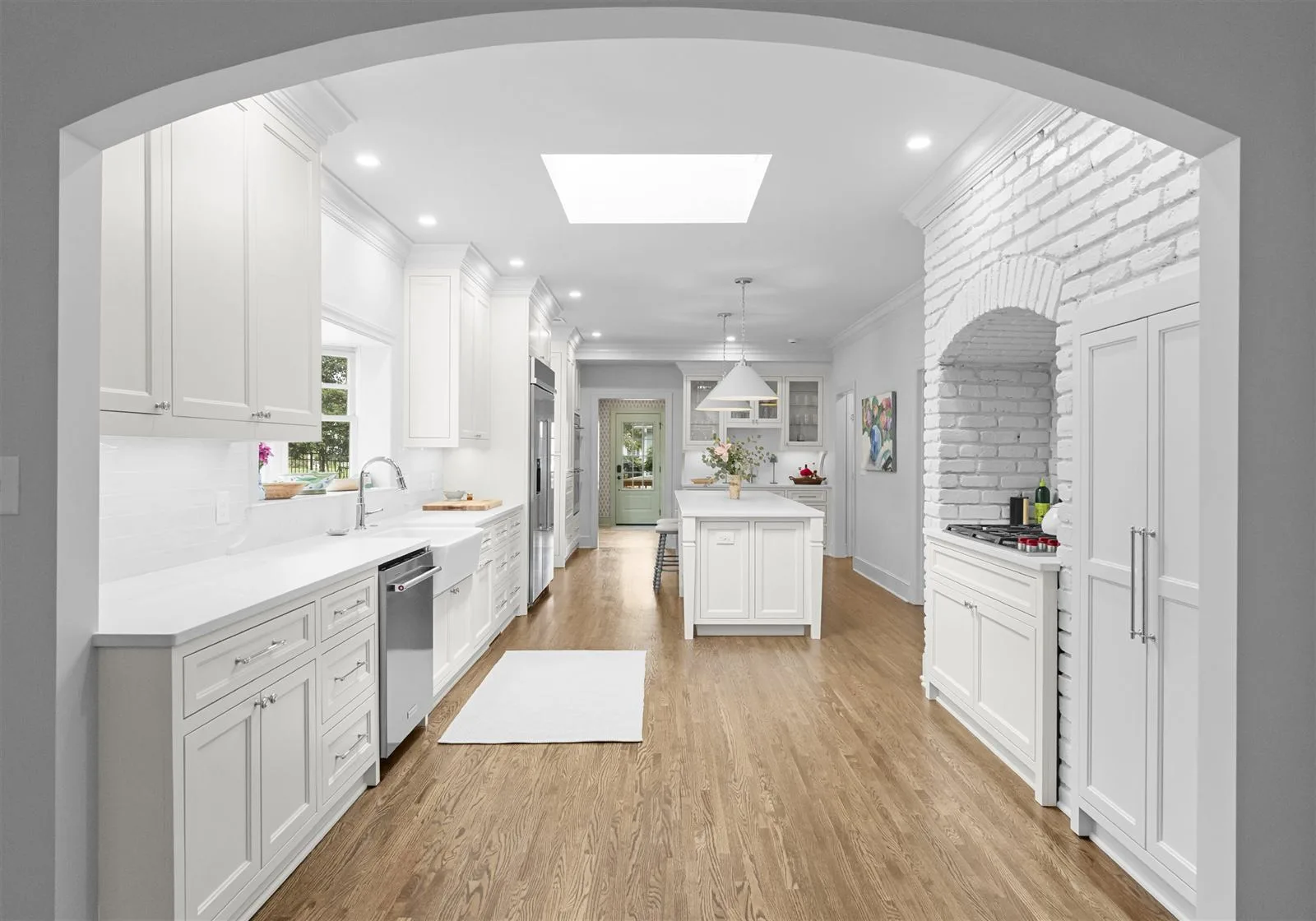
This family wanted to stay in Lansdowne. Instead of starting over, we added a two-level wing with a new garage, office and gym below and a primary suite above, rebuilt the kitchen, and put a new roof over the old house and the new so it reads as one building.
How we help you decide
The fastest way to an answer is an honest price for the renovation. It starts with a ten to fifteen minute discovery call with our pre-construction team, then a room-by-room deep dive into the house and what you want from it. If the project is a fit, the Red Light Review gives you a preliminary range for the renovation and the assumptions behind it. If that number is landing close to what a new house would cost, we will tell you, so you can make the call with real numbers in front of you instead of an assumption.
More on what drives renovation cost is in what a whole-home renovation costs in Charlotte.
Questions we hear about renovating versus rebuilding
Is it cheaper to renovate or tear down and rebuild?
Not as often as people assume. When a renovation touches most of the house, it and a new build frequently land at similar price points, and sometimes rebuilding is a little less. A smaller, well-targeted renovation usually is cheaper.
When does it make sense to tear down?
When the structure is failing, when the ceilings in an existing two-story house cannot be made the height you want, or when the renovation would change almost everything anyway. Zoning can also force the question.
Can I keep my house closer to the property line than today's rules allow?
Often, as long as you are renovating rather than replacing it. In Charlotte, a nonconforming house can be renovated without being brought into conformity, though an expansion has to meet today's standards, and a new house always does. Other towns, Davidson among them, use percentage tests that a large renovation can trip, so check with your town before you design.
Can a historic district stop me from tearing down?
In a Charlotte local historic district, the Historic District Commission cannot deny a demolition, but it can delay it for up to 365 days. Myers Park is on the National Register, which does not limit what a private owner can do, except in Hermitage Court, a local historic district inside it.
Do you build new homes too?
Rarely. Large renovations and additions are almost all of what we do, and our first instinct is always to keep the house. When a client already owns the lot and the house is not worth saving, a custom home is on the table, but it is the exception.
If you are weighing the two paths for your own house, see how we approach large renovations. The discovery call below is ten to fifteen minutes, and it is the first step toward a real number for your house.
