
The Short Answer
If your house is in one of Charlotte's eight local historic districts, exterior work needs approval before it needs a permit.
- Smaller changes can be approved by the city's staff. New construction, large additions and demolition go to the full Historic District Commission, which meets once a month.
- Most old houses in Charlotte are not in a local district at all. A National Register listing, like most of Myers Park, does not bring this review.
- Real ranges for Charlotte and Lake Norman projects are in our Investment Guide.
Charlotte has neighborhoods full of houses worth keeping, and owners who want to renovate or add on without losing what drew them there. If one of those houses sits inside a local historic district, there is one more step between your plans and your building permit: a design review by the city's Historic District Commission.
It is not a reason to avoid an old house. It is a step to plan for. Here is how to tell whether it applies to you, what needs approval, how the calendar works, and how to build it into your project from the start.
Is your house in a local historic district?
Charlotte has eight local historic districts: Dilworth, Fourth Ward, Hermitage Court, McCrorey Heights, Oaklawn Park, Plaza Midwood, Wesley Heights and Wilmore. The boundaries are specific, so check the city's map for your address rather than going by the neighborhood name.
That last point matters, because a lot of homeowners assume their neighborhood is a historic district when it is not, or not entirely:
- Myers Park is on the National Register, which does not limit a private owner. The exception is Hermitage Court, a local district inside Myers Park between Providence and Hermitage Roads.
- Plaza Midwood is a local district only at its core, around The Plaza and Thomas Avenue.
- Elizabeth is on the National Register but is not a local district. Eastover, Cotswold, Foxcroft and SouthPark are not local districts either.
The difference between the two kinds of listing is the whole story. A local district brings design review of exterior changes. A National Register listing is a mark of significance that can make a house eligible for tax credits, and on its own it does not bring that review.
What needs approval, and from whom
Inside a local district, the city requires a Certificate of Appropriateness before any exterior change, and there is no building permit for exterior work without one. Routine maintenance that changes nothing is usually not reviewed. Starting without approval can bring penalties. The city's own guide splits the work two ways.
Approved by staff
Smaller items can be approved by the Commission's staff, with no hearing: small additions, fences, retaining walls, windows and doors, work in the rear yard, driveways and some tree removal. Applications can go in at any time.
Heard by the full Commission
New construction, large additions, demolition, enclosing a front or side porch, substitute materials, large accessory buildings, major tree removal, front-yard parking and painting masonry that has never been painted.
Some properties sit in a lighter streetside overlay, which reviews only the front half of the lot. There, a rear addition is not reviewed unless it is taller or wider than the house.
Demolition has its own rule. The Commission cannot deny a demolition, but it can delay it for up to 365 days, which matters if you are weighing renovation against a teardown. We wrote about that choice in renovate or tear down.
Finalizing designs and scope in pre-construction is important. We won't start a project with a ton of unknowns.
 Max Messenger, Owner
How long approval takes
The calendar is set by the full Commission. In 2026 it meets on the second Wednesday of each month, and a complete application is due on the first Wednesday of the month before. From the deadline to the hearing is about five weeks, before any changes the Commission asks for.
Staff-level work does not wait for a meeting, which is why it pays to know early which side of the line your project falls on. A large addition that needs a hearing belongs in the plan from the first conversation, not discovered once the drawings are finished.
- Check the mapConfirm whether the lot is inside a local district or the streetside overlay.
- Talk with staffLearn early whether the work is a staff item or goes to the Commission.
- Design to the standardsDrawings that respect the house and the street are the fastest path.
- Apply for the CertificateA complete application, in time for the right deadline.
- Then the permitWith approval in hand, the building permit and construction follow.


How we plan for a historic house
An old house asks more of a project whether or not it sits in a district. A historic review is one more thing to settle before construction, alongside the drawings, the engineering and the selections, and settling things first is how we work.
- We check early. Whether a lot is in a local district or the streetside overlay is something to know at the start of pre-construction, because it changes the schedule.
- We bring in the right architect. A design that fits the house and the street is the best case for approval, which is one reason we match each project with its own architect.
- We build the calendar in. If the work needs a hearing, the application deadline goes into the project plan, so the start date accounts for it.
- We plan for the house itself. Homes built before 1978 fall under the EPA's lead-safe renovation rules, and older wiring and plumbing often need replacing once the walls are open.

Providence Park, Charlotte
Historic in character, not in a district.
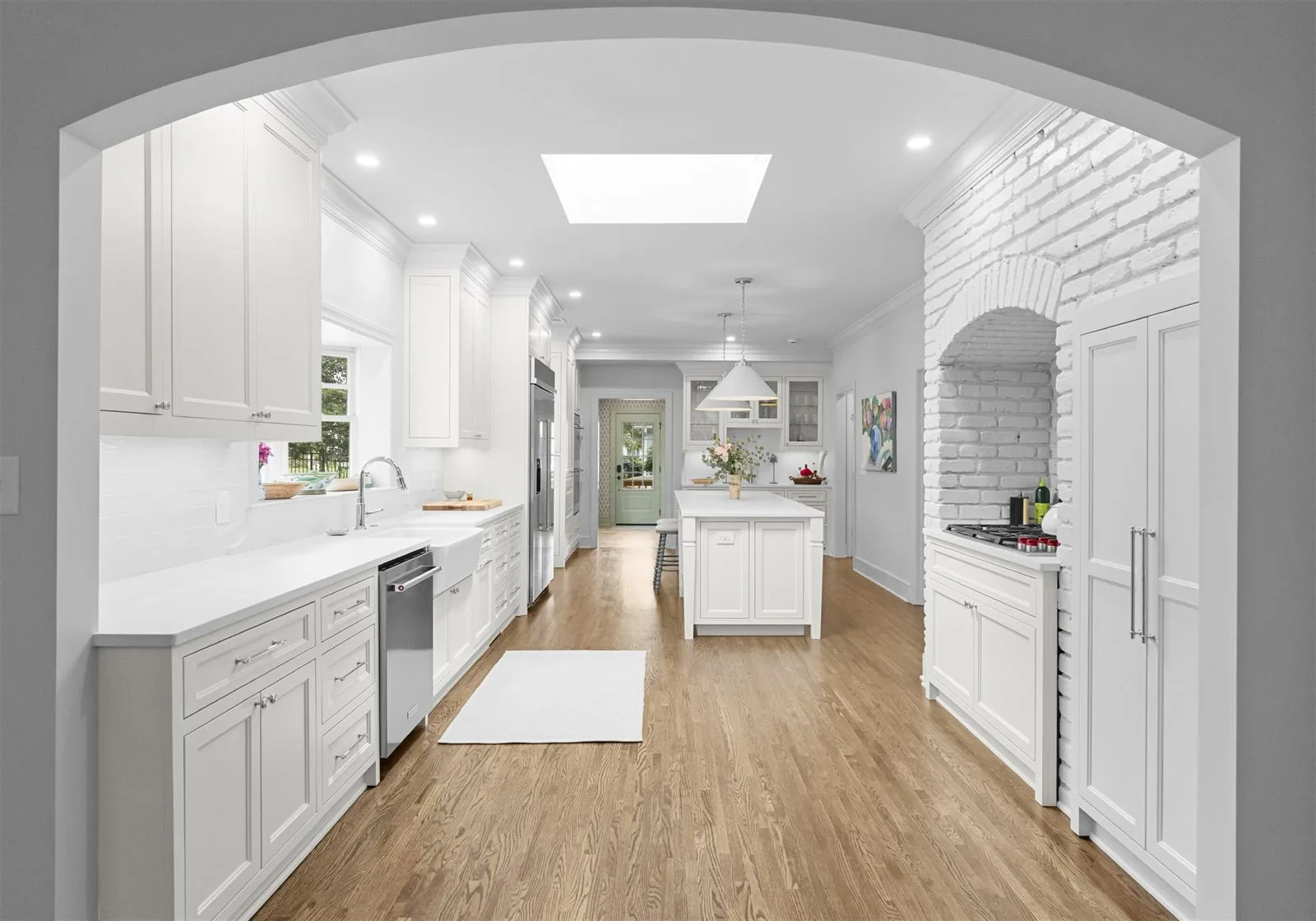
This 1955 house is the kind of home many Charlotte owners have: old enough to have real character, and outside the city's local historic districts, so the expansion needed no Commission review. We framed in the two-car garage to make room for a chef's kitchen, a mudroom and a large laundry, working with the architect to keep what made the house worth keeping.
Tax credits for historic homes
Local district status does not carry tax credits. A National Register listing can. North Carolina offers homeowners a 15 percent state tax credit for qualifying rehabilitation of an owner-occupied house that is individually listed or a contributing building in a National Register district. The work has to meet the federal standards for rehabilitation, and the State Historic Preservation Office reviews it, so talk with that office before work begins.
At a Glance
8
Local historic districts in Charlotte
Monthly
Commission hearings, second Wednesday
About 5 Weeks
From application deadline to hearing
15%
State credit, National Register homes
Questions we hear about historic districts
Does my historic district control what I do inside my house?
The Certificate of Appropriateness covers exterior changes. Interior renovation still needs the usual building permits, and an addition or any change to the outside of the house goes through the historic review first.
Is Myers Park a historic district?
Myers Park is on the National Register, which does not limit what a private owner can do. The exception is Hermitage Court, a local historic district inside Myers Park, where exterior changes need approval.
How long does historic district approval take in Charlotte?
Staff-level items can be approved without waiting for a meeting. Projects that go to the full Commission are heard at its monthly meeting on the second Wednesday, with complete applications due on the first Wednesday of the month before, so about five weeks from deadline to hearing.
Can I tear down a house in a historic district?
The Commission cannot deny a demolition in a local district, but it can delay it for up to 365 days. That delay is worth weighing early if you are deciding between renovating and rebuilding.
Does living in a historic district make a renovation cost more?
It can add design time and, for some items, materials chosen to match the house. The bigger effect is usually on the schedule, which is why we settle the review in pre-construction rather than discovering it later.
If you own an older home in Charlotte and want to know what a renovation or addition would take, the discovery call below is ten to fifteen minutes with our pre-construction team.


